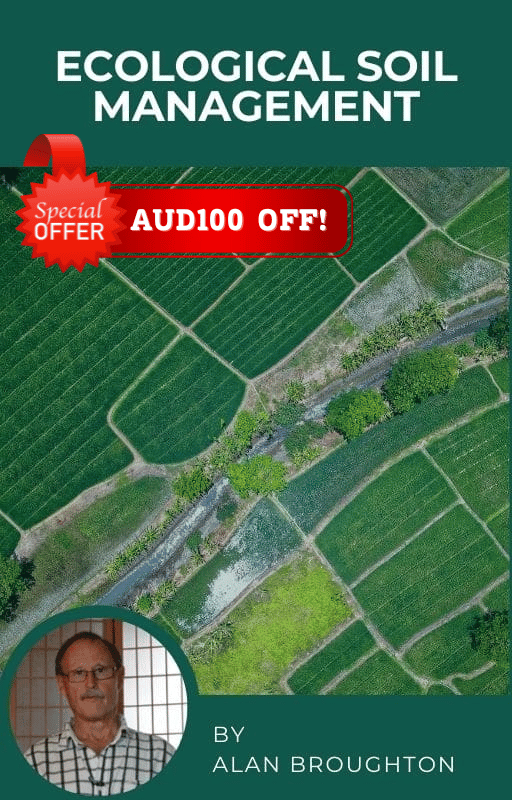
Ecological Soil Management

This course will unfold the complexity of soil as Alan explores how we can all understand our soil and how we manage them. Soil is the basis of sustainable agriculture. Animal health, weeds, pests and diseases of plants, human health, erosion, drought, flood, salinity and food production all depends on the fertility and the structure of the soil. Soil is also where the potential lies in reducing the carbon dioxide concentration in the atmosphere to sustainable levels. Soil loss has been a major factor in world history; soil loss can be reversed by sound agricultural practices that create soil.
Highly Recommended 4.8
Rated 5 out of 5
Ecological Soil Management Course with Limited discount offer
AUD $497.00
[sts_sales_trigger]
This course includes:
PLUS: 30-Day Money-Back Guarantee

What You Will Learn:

Who is this course is for:

For all farmers and anyone who wants to grow plants without using chemicals.

Discover how successful farmers create the perfect environment for profitable chemical free farming.

The Course begins as soon as you register. It’s a self-paced course where you can access the Lessons anytime once they are released. Lessons are written and presented by Alan Broughton. 

You have lifetime access to the course; once they are made available online they remain there for you to access permanently. 

You also get access to a study group to ask questions and online learning quizzes. 

At the end you also receive a Certificate of Completion!

Course Content

Expand All

Course Overview:

  • Topic 1: The Complexity of Soil
    • Relationship Between Soil Physics, Biology and Chemistry
  • Topic 2: Soil Organic Matter and Carbon
    • Ecological Soil Fertility Management Principles
  • Topic 3: Finding Local Soil Information
    • Soil Formation
    • Soils of Australia
  • Topic 1: The Soil Profile
    • Soil Profile Examination
  • Topic 2: Plants as Indicators of Soil Conditions
    • Weeds as Indicators of Soil Conditions
    • Symptoms of Nutrient Deficiency and Excess
  • Topic 3: Soil Fertility Monitoring
    • Useful Soil Fertility Monitoring Tools
    • Soil Laboratory Analysis
    • Taking Soil Samples
    • Soil Colour
    • Soil Texture Testing
    • Soil Structure
  • Topic 4: Easy Soil Tests to Do
    • Soil Stability: The Emerson Test
    • Acidity and Alkalinity
    • Salinity
  • Topic 1: Bacteria
    • Bacteria: Benefits, Nodulation of Legumes, Azotobacter, Actinobacteria)
  • Topic 2: Fungi
    • Fungi: Benefits, Mycorrhiza
  • Topic 3: Other Soil Micro-Organisms
    • Archaea
    • Protozoa
    • Nematodes
    • Algae
    • Encouraging Micro-Organisms
  • Topic 4: Providing Best Conditions for Micro-Oganisms
    • Bacteria-Fungi Balance
    • Soil Biology Monitoring: Using a Microscope, Lab Testing
  • Topic 5: Larger Critters in The Soil
    • Non-Microbial Soil Life: Collembola, Mites, Dung Beetles, Earthworms
  • Topic 1: Soil Fertilisation: From The Romans to Albrecht
  • Topic 2: Reading a Soil Test
    • Soil Testing versus Foliar Testing
    • Chemical Symbols
  • Topic 3: The Major Cations
  • Topic 4: Anions
    • Oxygen
    • Silicon
  • Topic 5: Trace Elements
  • Topic 1: Soil Aeration
  • Topic 2: Compost Making
    • Biodynamic farming
    • Compost making: materials, method, usage
    • Compost tea and compost extract
  • Topic 3: Worm Farming And Vermicompost
  • Topic 4: Green Manures And Legume Herbs And Trees
    • Soil fertility trees
  • Topic 5: Compost Tea, Compost Extract And Manure And Weed Teas
    • Manufactured organic fertilisers
    • Biological preparations and stimulants
    • Manure and weed teas
  • Topic 6: Biological
    • Preparations And Stimulants
    • Coal, ash, charcoal
    • Rock dust, paramagnetism
    • Foliar fertilising
    • Animals as soil improvers
  • “If some are suppressed, others will take their place”
  • “Microbes recover”
  • “Fertilisers increase carbon sequestration by increasing growth” 
  • Not all chemicals harm all biology: Balance is changed 
  • Most valuable are most affected: Mycorrhiza, nitrogen fixers, methanotrophs, disease suppressors, earthworms 
  • Less than 20% of pesticides have ever been tested for soil biology effects 
  • Studies often short term, lab based, using active ingredients only, only measuring biomass 
  • Roundup is registered as an antibiotic 
  • A scientific literature ignored Are chemicals sacred?

Presenter: Alan Broughton

Author, Biological Agriculture Researcher & Organic Farming Teacher. From a small Merino farm in NE Victoria. B.Arts (Monash 1971), Cert. Horticulture (Burnley 1975), Graduate Diploma Sustainable Agriculture (Orange 1998). Involved with Organic Agriculture Association (Gippsland) since 1985, currently vice-president. Nursery work. Small organic producer (certified by NASAA for 5 years). Wrote and taught Diploma of Organic Farming 2001-2016 (NMIT, Federation Training).

- Get Instant Access -

AUD $497.00
[sts_sales_trigger]
Risk Free: 30-Day Money-Back Guarantee

Omg... this sale is crazy!

Days
Hours
Minutes
Seconds

hurry up and grab these deals: